
Setting & Infrastructure 2025
Setting & Infrastructure at Glance
SI 1: Open Space
SI 2: Forest Vegetation Area
SI 3: Planted Vegetation Area
SI 4: Area for Water Absoption
SI 5: Green Space per Population
SI 6: University Budget for Sustainability
SI 7: Accessible and Inclusive Campus Facilities
SI 8: Security and Safety Facilities
SI 9: Health Infrastructure
SI 10: Conservation
SI 11: ICT Utilization
The Ratio of Open Space Area to Total Area

Across all 18 IPB University campus sites, research farms, and conservation areas, open spaces overwhelmingly dominate the institutional landscape. Spanning a total area of 1,668.68 hectares, the university dedicates 1,606.75 hectares as open space—representing 96.29% of its total land area. This multi-campus landscape is thoughtfully managed to harmonize academic innovation with large-scale environmental conservation.
Summary of IPB University Open Space Area (2024)
| Description | Total area |
|
Total campus area (m2) |
16,686,843 |
|
Total ground floor area (m2) |
619,301 |
|
Total open space area (m2) |
16,067,542 |
|
The ratio of open space area to total area |
96.29 % |
Total Area on Campus Covered in Forest Vegetation Used for Research, Teaching, and Community Engagement

Forest vegetation exist in three campus sites of IPB University, namely the IPB Dramaga Campus, Gunung Walat University Forest (Hutan Pendidikan Gunung Walat/HPGW), and Tinjil Island (Pulau Tinjil) with a total of 8,384,239 m2.
Total Area on Campus Covered in Planted Vegetation
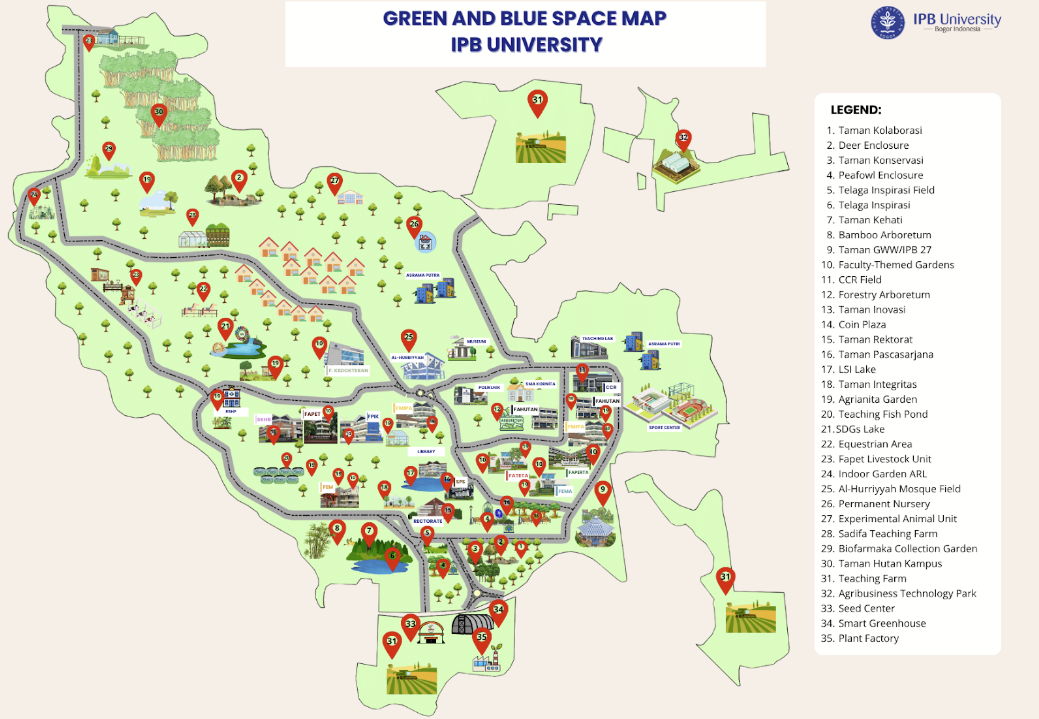
All the sites of IPB University covered by planted vegetation have a total area of 7,115,494 m2 or 42.64% of the total campus area.
Total Area on Campus for Water Absorption besides the Forest and Planted Vegetation
As part of its commitment to sustainable campus infrastructure, IPB University actively maintains dedicated water absorption areas across its operational sites to support natural groundwater recharge, preserve hydrological balance, and minimize surface runoff.
Based on spatial digitization and land-cover mapping updated as of August 25, 2025, across 18 campuses, research farms, and field stations, IPB University’s total water absorption area—excluding forest and planted vegetation—reaches 517,821 m², accounting for 3.10% of the university’s total area of 16,686,843 m². These permeable surfaces include open ground surfaces and supporting water-infiltration infrastructure across various operational units.
Open Space Area per Campus Population

IPB University is committed to providing a spacious, green, and healthy environment for its academic community. Covering a total campus area of 1,668.68 ha with a building footprint of 619,301 square meters, the university dedicates 16,067,542 square meters specifically to open spaces—such as parks, gardens, pedestrian walkways, and outdoor sports facilities. Serving a total campus population of 40,861 students and staff, IPB University provides an open-space ratio of 393.22 square meters per person.
University Budget for Sustainability Effort (USD)
The average percentage university budget for IPB university is 26.80%. The funds are used to support sustainable facilities, transportation, personnel costs, infrastructures, research, other projects, and events at IPB University.
| 2022 | 2023 | 2024 | Average | |
| Budget Total | $ 121,910,405 | $ 115,095,872 | $ 141,252,000 | $ 126,086,092 |
| Sustainability Budget | $ 32,441,172 | $ 30,831,660 | $ 38,107,795 | $ 33,793,542
|
| Percentage | 26.80 % |
| Item 1.17 | Value 2024 ($) |
| FACILITIES | 13,206,873 |
| TRANSPORTATION | 300,000 |
| PERSONNEL COST | 6,573,427 |
| INFRASTRUCTURES | 6,334,694 |
| RESEARCH | 10,387,265 |
| OTHER PROJECTS AND EVENTS | 1,305,535 |
| TOTAL | 38,107,795 |
Campus Facilities for Disabled, Special Needs and Maternity Care
IPB University provides various facilities to support accessibility for persons with disabilities, special needs, and maternity care. These facilities include:
- Disabled Ramp
Ramps are provided at various building entrances to facilitate access for wheelchair users and individuals with mobility limitations. - Parking Area for Disabled
Special parking areas are designated close to building entrances to ensure accessibility for persons with disabilities. - Disabled Path Pedestrian (Yellow Tactile Pathway)
Yellow tactile pathways are installed along sidewalks to guide visually impaired individuals safely across campus areas. - Toilet for Disabled (Handgrip Toilet)
Toilets equipped with handgrips are available in campus buildings to ensure safety and comfort for people with disabilities. - Lactation Room
A private lactation room is provided for breastfeeding staff and lecturers to pump milk comfortably in a clean and private environment. - Elevator Buttons with Braille Letters
Elevators in campus buildings are equipped with buttons labeled in Braille to assist visually impaired users. - Daycare (Agriananda Childcare)
Agriananda serves as a daycare facility for the children of lecturers and staff, supporting maternity needs and work-life balance. - Accessible Waiting Seat
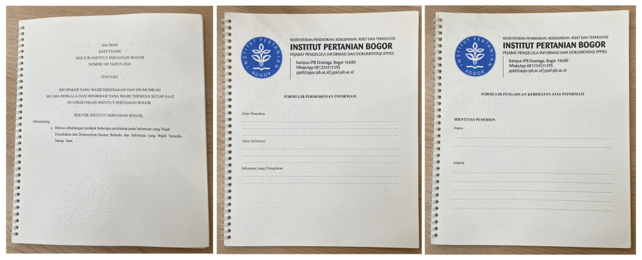
Waiting areas in campus buildings include seating designed for easy access and comfort for people with special needs. - Copies of the Public Information List Decision, Information Request Form, and Objection Form in Braille
Provision of public information documents in Braille format reflects IPB University’s Inclusive and Open Behaviour (IOB) by ensuring equal access to information services for persons with visual impairments.
All supporting facilities are available across IPB University campuses, demonstrating IPB’s strong commitment to inclusivity and accessibility. These provisions ensure equal opportunities for all members of the campus community to participate fully in academic and daily activities.


Security and Safety Facilities

IPB has been equipped with CCTV spread throughout the campus site which amounts to 122 CCTVs in strategic areas. CCTV is used to monitor for 24 hours non stop. The use of CCTV is used to support security guards in monitoring effectively. In each faculty there are several security guards who are available for 24 hours to respond to various incoming reports and maintain security. The strengthening of safety and security is also shown by IPB through its commitment to conduct HSE training to all staff and lecturers. This is an important commitment owned by IPB so that all its citizens can do the first response if there is an undesirable event before being able to call the relevant authorities.
Security and safety facilities:
- CCTV at entire place of IPB University campus, namely: parking lot and public area, AHN Building, SSC Building, Library, Auditorium FMIPA, GWW, FATETA
- Fire hydrant di IPB University
- Concave mirror at Taman Integritas
- Security’s Handy talky
- Differentiation between pedestrian, bicycle line, and vehicle
- Street Signs
- Warning board at lake
- Campus security unit
- K3L training to all lecturers and staff at IPB university
Health Infrastructure Facilities for Students, Academics and Administrative Staffs’ Wellbeing


The IPB Health Unit provides basic health care services and medical treatment for the academic community, education staff, and their immediate families, as stated in IPB MWA Regulation No.1/IT3.MWA/OT/2018 Article 123. Currently, IPB operates two clinics located at Dramaga Campus and Gunung Gede–Cilibende Campus.
To ensure optimal health services, the Health Unit continues to improve its facilities and infrastructure, including medical equipment and clinic buildings, to meet standards of safety, comfort, and accessibility for all patients, including persons with disabilities, children, and the elderly. Professional management is applied to prioritise effective, efficient, and safe services for the IPB community.
Health Services Available
- IPB Health Clinic (Klinik IPB) serves as the primary medical service provider for students and staff, offering general health consultations, medical check-ups, and treatment.
- Emergency services and first aid are available at the clinic to handle urgent health issues on campus.
- Laboratory services are provided for basic medical tests and early disease detection.
- Pharmacy services are available at the clinic to dispense prescribed medicines and basic health supplies.
- Dental care services are offered to maintain the oral health of students and staff.
- Mental health and counselling services are accessible for students through the Direktorat Kemahasiswaan dan Pengembangan Karir, supporting psychological well being and stress management.
- Vaccination programs, including COVID-19, influenza, and routine immunisation, are facilitated in collaboration with local health authorities.
- Health promotion campaigns (e.g. seminars, workshops, and awareness programs) are regularly held to encourage healthy lifestyles in the campus community.
- Occupational health and safety services are integrated to ensure that academic and administrative staff are protected from work-related health risks.
- Partnership with local hospitals such as RS Medika Dramaga and RSUD Cibinong provides referral access to advanced healthcare when needed.
- Periodic medical check-ups are organised for staff to monitor long-term health and wellbeing.
- Student insurance scheme (BPJS Kesehatan or equivalent) ensures financial accessibility to healthcare facilities outside campus.
Conservation: Plant (Flora), Animal (Fauna), or Wildlife, Genetic Resources for Food and Agriculture
Secured in Either Medium or Long-term Conservation Facilities

IPB University officially declared itself a Biodiversity Campus on 5 June 2016, coinciding with World
Environment Day. The initiative was led by the Student Association of Forest Resources Conservation
and Ecotourism (HIMAKOVA) in collaboration with the Department of Forest Resources Conservation
and Ecotourism (KSHE), Faculty of Forestry and Environment, IPB University.
The declaration aimed to position the IPB Dramaga Campus as a miniature conservation area and a
living laboratory for biodiversity conservation. The campus serves as a hub for research, education, and
conservation outreach for both the academic community and surrounding society. Through this
milestone, IPB University became the first higher education institution in Indonesia to be recognised as
a Biodiversity Campus.
HIMAKOVA supports this commitment through continuous conservation activities, including the
development of field guides for mammals, birds, reptiles and amphibians, insects, and butterflies, as
well as regular biodiversity monitoring conducted by its specialist observer groups. A Campus
Biodiversity Exploration held on 2 November 2025 further introduced campus biodiversity by engaging
participants in direct observation of flora and fauna across selected campus locations, fostering
awareness and interest among students and pupils.
Conservation efforts are also strengthened by Uni Konservasi Fauna (UKF), a university-level student
organisation involving members from various academic backgrounds. UKF focuses on wildlife
conservation through activities such as species monitoring, rehabilitation, and community engagement.
During the Asia Nature Challenge 2025, UKF conducted a biodiversity inventory at the IPB Dramaga
Campus, recording 311 observations representing 156 species across multiple taxa over four days. The
results demonstrate the richness of campus biodiversity and reinforce conservation practices through
citizen science using the iNaturalist platform.
Planning, Implementation, Monitoring and/or Evaluation of All Programs Related to Setting and Infrastructure through the Utilization of Information and Communication Technology (ICT)
In this indicator, IPB University has implemented ICT to control the parameters of the Setting and Infrastructure. The DUI dashboard is used to monitor land use, development, and space. Additionally, IPB University is also developing a sustainability dashboard (web) used to control parameters (electricity, water, vehicles). Development has begun to monitor campus air quality with the integration of real-time data measurements directly into the Airmon website. This air quality control can serve as a baseline for policy decisions to be made by IPB University.
