Enviromental Impact

ENVIRONMENTAL IMPACT
“Environmental impact is defined as any change to the environment, whether adverse or beneficial, resulting from a facility’s activities, products, or services. In other words, it is the effect that people’s actions have on the environment”
– US Environmental protection agency
Environmental Sustainability
IPB University formally established its commitment to the Sustainable Development Goals (SDGs) in 2020 through the issuance of Rector’s Decree No. 133/IT3/LK/2020. This milestone marked the University’s strategic alignment with global sustainability agendas and its dedication to integrating SDG principles into institutional policies and practices.
To further strengthen this commitment and reinforce its role as a sustainable campus actively contributing to the achievement of the SDGs, IPB University has reaffirmed its position through the issuance of Rector’s Decree No. 428 of 2025. This renewed policy underscores the University’s continuous efforts to advance sustainable development across its academic, research, and community empowerment activities.
IPB University has established Rector Regulation No. 6 of 2024 on Procurement of Goods and Services as an official guideline to ensure that procurement processes within the University are conducted in an orderly, efficient, transparent, and accountable manner. As outlined in the purpose and objectives section (page 6), the regulation is designed to ensure that all procurement activities funded by institutional resources are carried out effectively, openly, competitively, fairly (non-discriminatory), and flexibly in accordance with organizational needs.
The regulation comprehensively covers all aspects of procurement, including general provisions and definitions, principles and ethics, roles and authorities of involved parties, and key implementation stages such as planning, supplier selection, contract types, payment procedures, as well as monitoring and sanctions. It also addresses specific mechanisms, including non-competitive procurement, self-managed work, the use of domestic products, human resource development, and transitional provisions. Overall, this regulation serves as a comprehensive framework to ensure that procurement practices at IPB University adhere to the principles of good governance.
IPB University has established a Rector’s Decree No. 426 of 2025 on Sustainable Investment Policy as a strategic framework to guide institutional investment practices in alignment with sustainability principles. This policy aims to integrate Environmental, Social, and Governance (ESG) considerations into all investment decisions, ensuring that investments generate not only financial returns but also positive environmental and social impacts while supporting the achievement of the Sustainable Development Goals (SDGs).
The policy outlines key principles of ESG-based investment, identifies priority sectors such as renewable energy, green infrastructure, and sustainability-driven innovation, and sets clear limitations on investments that may pose risks to the environment, society, or the institution’s reputation. It also emphasizes governance mechanisms that promote transparency, risk management, and accountability, ensuring that all investment activities are conducted in a responsible and sustainable manner.
Students at IPB University actively conduct outreach educational activities for the wider community whose purpose is to engage with sustainability. This is part of the IPB University Tridharma. These activities are implemented at various scales with various topics according to core competence developed by students. The followings are several outreach educational activities implemented:
- IPB Sustainability Science Research Students Association (SSRS)
- Tree Grow Community (TGC)
- Nature Lovers Student Association (LAWALATA)
- Forester Nature Lovers Faculty of Forestry IPB (RIMPALA)
- Uni Konservasi Fauna (UKF)
- Resources and Environmental Economics Student Association (REESA)
- Indonesian Green Action Forum (IGAF)
- Forest Resource Conservation and Ecotourism Student Association (Himakova)
- Forest Management Students’ Club
- Forest Products Student Association (Himasiltan)
- Applied Meteorological Student Associaation (Himagreto)
- Marine Science and Technology Student Association (Himiteka)
- Soil Science Student Association (HMIT)
- Society of Renewable Energy IPB University (SRE IPB)
IPB University reaffirms its commitment to supporting national policies and global initiatives in reducing carbon emissions through the issuance of a Rector’s Decree on the achievement of carbon neutrality. Building upon the earlier commitment outlined in Rector’s Decree No. 298/IT3/LK/2020, the university has updated its strategy to establish a more realistic, measurable, and sustainable pathway toward carbon neutrality by 2045 through Rector’s Decree No. 427 of 2025 on Efforts to Achieve Carbon Neutrality by 2045. This renewed commitment aligns with evolving national regulations, including Indonesia’s long-term target of achieving carbon neutrality by 2060, and reflects the university’s proactive role in advancing environmental sustainability.
Through this integrated framework, IPB University ensures that its carbon neutrality efforts are carried out systematically, continuously, and in alignment with both institutional priorities and global sustainability goals.
IPB University has 34 research centers covering various fields. These research centers are grouped into five areas, where each area is coordinated by an International Research Institute (IRI). The five IRI include: i) Maritime, Ocean and Fisheries; ii) Advance Technology; iii) Environment and Climate Change; iv) Food, Nutrition, Health and Halal; and v) Social, Economic and Regional Development.
Under the coordination of International Reseac through interdisciplinary collaboration, innovative research, teaching, and community engagement, Some of these research centers are dedicated to addressing sustainability challenges, including:
- Environmental Research Center;
- Center for Coastal and Marine Studies;
- Center for Transdisciplinary and Sustainability Sciences;
- Center for Climate Risk and Opportunity Management in Southeast Asia Pacific;
- Mining Reclamation Study Center.
Each research center has their own research and academic staff. In addition, faculty members may also involve in research centers.
Environmental Education
Education for SDGs Commitment Meaningful Education
IPB University demonstrated a deep and structured commitment to providing meaningful education around the Sustainable Development Goals (SDGs) that reaches all students and disciplines across the university. This commitment is realized through formal curriculum integration, transdisciplinary learning platforms, and multi-university collaborations designed to build sustainability awareness and action among the entire academic community.
IPB Curriculum 2020 (K2020) is structured as follows:
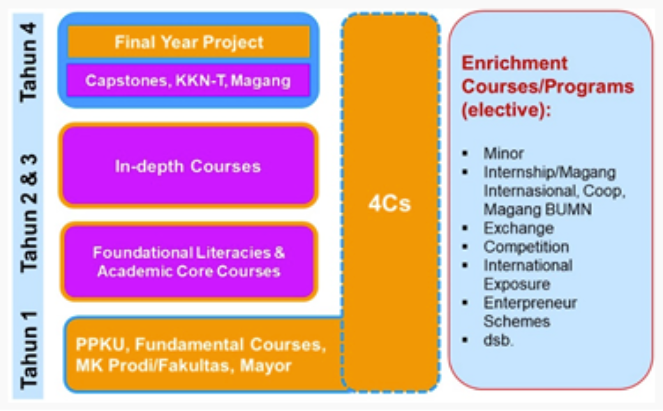
Based on this curriculum, courses offered to students are classified into three categories which are mandatory for each student, namely Common Course at Year 1, Foundational Literacies and Academic Core Courses at Year 2 and 3, and Final Year Project at Year 4. Each category includes SDGs-related content in its materials, such as climate change, food security, waste management, and sustainable resource use.
This mandatory education also includes community development (Kuliah Kerja Nyata Tematik-KKNT) as part of the Final Year Project, where students are sent to rural areas to practice and share their knowledge as well as to learn from the community in achieving SDGs. Every year, IPB University deploys more than one thousand students to carry out community outreach programs through the Kuliah Kerja Nyata (KKN) scheme, which includes educational and capacity-building activities tailored to local community needs. IPB provides training for students before they depart to the field. IPB collaborates with local governments in implementing this program.
IPB also implements learning programs to enhance quality education and to support students in developing their potency. There are two main programs conducted in 2024, namely leadership training called “Asrama Kepemimpinan” and IPB Innopreneurship Program. Both programs facilitate the development of students and skills, based on Talent Mapping conducted for first year students annually. The result of talent mapping has informed us of a better strategy to provide a better learning channel for our students. The latest talent mapping results indicate that more than 40 percent of students have talent and are interested in becoming entrepreneurs. IPB Innopreneurship Program constitutes a learning channel to facilitate students to learn more about social entrepreneurship, as shown in the figure below.
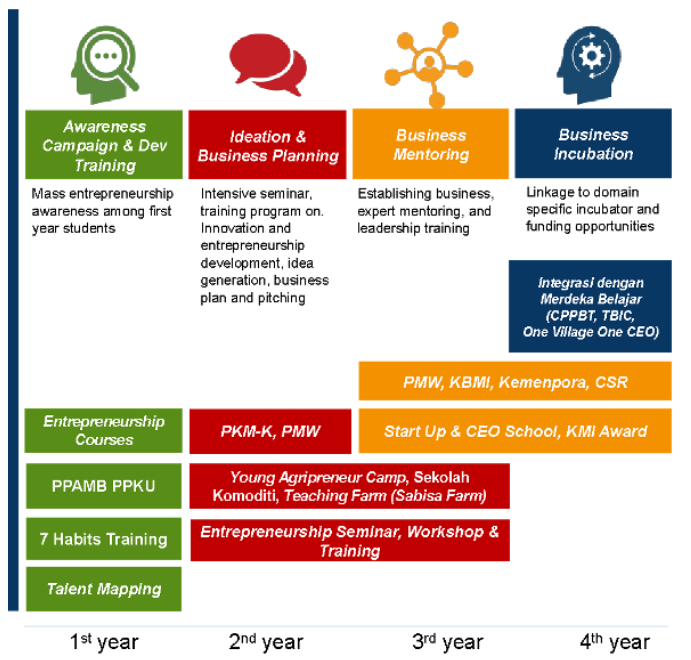
Figure: IPB Innopreneurship Program
Dedicated Courses that Address Sustainability and the SDGs
IPB University has a mandate to advance science in the fields of agriculture, marine, and biosciences. Therefore, IPB offers both full degrees and elective courses that address sustainability and the SDGs.
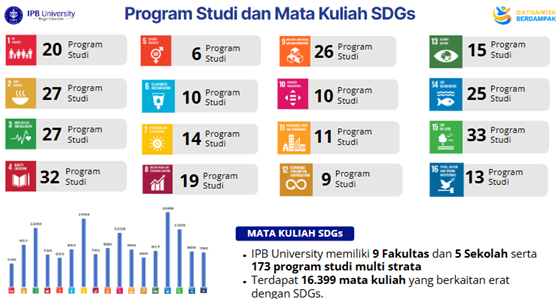
IPB has 173 study programs of multistrata across 9 faculties and 5 schools, which offer 16.399 courses. Those courses are closely related to SDGs. We have systematically mapped the curriculum based on the 17 SDGs, as indicated by the figure below. This study program map indicates that sustainability principles are not limited to environmental fields but embedded in economics, social sciences, health, engineering, and communication disciplines.
To mention a few full degree programs that strongly address sustainability and the SDGs, among others:
- Bachelor of Environmental Resource Economics, which focuses on managing natural and environmental resources from a sustainable economic perspective.
- Bachelor of Forest Resources Conservation and Ecotourism program emphasizes the preservation and sustainable management of forest resources—including flora, fauna, and ecosystems—as well as the development of ecotourism.
- Bachelor of Smart Agriculture
- Master Program on Natural Resources and Environmental Management (PSL) program, a transdisciplinary and sustainability science program that examines the environmental, economic, and social aspects of sustainable natural resource governance.
FULL DEGREE PROGRAM
As mentioned previously, full degree programs at IPB refer to K2020 which comprises three course categories. This curriculum structure is applied for bachelor, master and doctoral programs, which mark strong milestones to build student competency. Here are some explanations about the K2020 structure.
Common Courses and Fundamental Courses
All first year students at IPB must take several Common Core Courses (CCC) and Fundamental Course (faculty-specific courses) the General Competency Education Program or Program Pendidikan Kompetensi Umum (PPKU) for two semesters, regardless of their major. The PPKU curriculum emphasizes holistic learning and the development of future-ready competencies, integrating sustainability values, environmental awareness, ethics, and social responsibility. Common Core Courses are the basis for the formation of Critical & Complex Problem Solving, Creative Thinking, Collaboration, and Communication (4C’s) and Character Qualities.
Subjects offered in the PPKU and Its SDGs content are listed below:
| Cluster |
Subjects |
SDGs content |
| National Compulsory | Religion
|
SDG 16 (students
takes respective subject, based on their religion) |
| Pancasila Education | SDG16 | |
| Civic Education | SDG16 | |
| Indonesian Language | SDG 4 | |
| English | SDG 4 | |
| Science and Technology | Basic Biology | SDG 15 |
| Physics for Science & Technology | SDG 9 | |
| Chemistry for Science & Technology | SDG 9 | |
| Economics | SDG 8 ; SDG 10 | |
| Agriculture | SDG 2 | |
| Science and Society | General Biology | SDG 15; SDG 12 |
| Physics for the Social Sciences | SDG 9; SDG 11 | |
| General Chemistry | SDG 12; SDG 6 | |
| Basic Economics | SDG 8; SDG 10 | |
| Innovative Agriculture | SDG 2 ; SDG 13; SDG 12 | |
| Basic Chemistry | SDG 12; SDG 9 | |
| Analysis of Biological Materials | SDG 12; SDG 9 | |
| Soils in the Agriculture–Environment Nexus | SDG 2; SDG 15; SDG 13 | |
| Veterinary Profession & Animal Welfare | SDG 3; SDG 15 | |
| Veterinary Anatomy I | SDG 3 | |
| Innovative Animal Husbandry | SDG 2; SDG 12 | |
| Forestry Science & Environmental Ethics | SDG 15; SDG 13 | |
| Conservation of Biological Resources & Environment | SDG 15 | |
| Basic Nutrition Science | SDG 2; SDG 3 | |
| Mobility & Competency Development | SDG 4; SDG17 | |
| Quantitative Reasoning (QR) | Mathematics and Logical Thinking | SDG 4; SDG 9 |
| Statistics and Data Analysis | SDG 4; SDG 9 | |
| Computational Thinking | SDG 9 | |
| Calculus I | DG 4; SDG 9 | |
| Business Decision Instruments | SDG 8; SDG 9, SDG 12 | |
| Entomology | SDG 2; SDG 15 | |
| Introduction to Fisheries & Marine Sciences | SDG 14 | |
| Sociology/Humaniora | Sociology | SDG 10; SDG 11; SDG 16 |
| Human Development & Natural Resources | SDG 8; SDG 12 | |
| Management | SDG 8; SDG 9 | |
| Entrepreneurship & Leadership | SDG 8; SDG9 | |
| Healthy Life/Sport/ Art | Sports/Arts | SDG 3 |
| Sketching | SDG 11 | |
| Competitions | SDG 4; SDG 9 | |
| Talents & Community Service | SDG 3; SDG 11; SDG 17 |
Study Program-specific Courses
Study Program-specific courses comprises foundational literacies, academic core courses and in-depth courses. These subjects are taken after students pass their first year at PPKU. As the courses are very much relevant to agriculture and natural resources uses, SDGs-related content is very strong in every course offered.
An example of courses offered at the Study Program Environmental Resource Economics
| Subjects | SDGs content |
|---|---|
| Food Science Research Methods | SDG 4, SDG 9 |
| Macroeconomic Theory I | SDG 8, SDG 9 |
| Microeconomic Theory I | SDG 8, SDG 9, SDG 12 |
| Statistical Methods for Agricultural & Resource Economics | SDG 4, SDG 9 |
| Mathematical Economics | SDG 4, SDG 9 |
| Agricultural & Food Economics | SDG 2, SDG 8, SDG 12 |
| Natural Resource Economics | SDG 6, SDG 7, SDG 12, SDG 13, SDG 14, SDG 15 |
| Environmental Economics | SDG 6, SDG 12, SDG 13, SDG 16 |
| Applied Economics for Agriculture & Resources | SDG 2, SDG 12, SDG 15 |
| Basic Econometrics for Agriculture & Resources | SDG 4, SDG 9 |
| Tourism Economics & Digital Nomads | SDG 8, SDG 11, SDG 12 |
| Production Economics | SDG 8, SDG 9, SDG 12 |
| Valuation of Natural Resources & Environment | SDG 12, SDG 13, SDG 15 |
| Natural Resource Economics II | SDG 7, SDG 12, SDG 13, SDG 14, SDG 15 |
| Agricultural Price Theory | SDG 2, SDG 8, SDG 12 |
| Agricultural Trade | SDG 2, SDG 8, SDG 12, SDG 17 |
| Climate Change & Disasters | SDG 11, SDG 13 |
| Applied Econometrics for Agriculture & Resources | SDG 4, SDG 9 |
| Cost–Benefit Analysis | SDG 9, SDG 12, SDG 13 |
| Economic Assessment of Natural Resource & Environmental Damage | SDG 12, SDG 13, SDG 15 |
| Modeling for Agriculture & Resources | SDG 2, SDG 9, SDG 12, SDG 15 |
| Sustainable Development in Agriculture, Resources & Environment | SDG 2, SDG 12, SDG 13, SDG 15, SDG 17 |
| Marketing & Market Analysis | SDG 8, SDG 12 |
| Agricultural & Food Policy | SDG 2, SDG 12, SDG 16 |
| Political Economy of Natural Resources |
SDG 12, SDG 16, SDG 15 |
An example of courses offered at the Study Program of Master’s in Food Science
| Subjects | SDGs content |
|---|---|
| Food Science Research Methods | SDG 4, SDG 9 |
| Statistics for Engineering | SDG 4, SDG 9 |
| Chemistry of Food Microbiology | SDG 12, SDG 9 |
| Advanced Food Microbiology | SDG 3, SDG 2, SDG 12 |
| Food Process Engineering | SDG 9, SDG 12 |
| Molecular Biochemistry of Food | SDG 3, SDG 9 |
| Advanced Food Analysis | SDG 12, SDG 9 |
| Food Ingredients and Additives | SDG 12, SDG 3 |
| Flavor Chemistry | SDG 12, SDG 9 |
| Applications of Metabolomics in Food Science | SDG 9, SDG 3, SDG 12 |
| Microbiological Quality Control of Foods | SDG 3, SDG 12 |
| Food Safety Microbiology | SDG 3, SDG 2, SDG 12 |
| Food Biotechnology | SDG 9, SDG 2, SDG 3 |
| Principles of Food Processing | SDG 9, SDG 12 |
| Sensory Science | SDG 3, SDG 12 |
| Food Packaging and Storage Engineering | SDG 12, SDG 9 |
| Membrane Technology in the Food Industry | SDG 6, SDG 12, SDG 9 |
| Cellular Metabolism of Food Components | SDG 3 |
| Methods for Evaluating the Biological Value of Foods | SDG 3 |
| Functional Food Development | SDG 3, SDG 2 |
| Food Toxicology | SDG 3, SDG 12 |
| Special Topics for Career Development |
SDG 4, SDG 8, SDG 9 |
An example of courses offered at the Study Program of Forest Products Science & Technology curriculum (K-2020, Master & Doctoral)
| Subjects | SDGs content |
|---|---|
| English (Academic) | SDG 4 |
| English (Doctoral) | SDG 4 |
| Statistical Analysis | SDG 4 SDG 9 |
| Research Methodology | SDG 4 , SDG 9, SDG 16 |
| Wood Science | SDG 12, SDG 15 |
| Biomaterial Physics | SDG 9, SDG 12, |
| Biomaterial Mechanics | SDG 9, SDG 12 |
| Biomaterial Chemistry | SDG 12, SDG 9 |
| Wood Deterioration | SDG 12, SDG 15 |
| Biomaterial Adhesion Technology | SDG 9, SDG 12 |
| Ultrastructure of Wood Cell Walls | SDG 15, SDG 9, SDG 12 |
| Wood Surface Coating | SDG 12, SDG 9 |
| Biology of Termite | SDG 15, SDG 12, SDG 11 |
| Biocomposites Technology | SDG 9, SDG 12 |
| Non-Wood Fiber Composite | SDG 12, SDG 9, SDG 15 |
| Advanced Biomaterial Composite | SDG 9, SDG 12 |
| Non-destructive Forest Products | SDG 9, SDG 12, SDG 11 |
| Renewable Materials & Sustainable Construction | SDG 11, SDG 12, SDG 9, SDG 13 |
| Pulp and Natural Fiber Science | SDG 12, SDG 6, SDG 9 |
| Lignocellulosic Biorefinery | SDG 12, SDG 9, SDG 7 |
| Forest Products Extractives | SDG 12 |
| Optimization in Forest Products Industry | SDG 9, SDG 12, SDG 8 |
| Econometrics Model for Forest Products | SDG 9, SDG 8, SDG 12 |
| Wood Machining Analysis | SDG 9, SDG 12 |
| Wood Acoustics | SDG 11, SDG 9 |
| Viscoelastic Materials | SDG 9 |
| Forest Products Industrial Economics | SDG 8, SDG 9, SDG 12 |
| Forest Products Policy Analysis | SDG 12, SDG 16, SDG, 8 |
| Philosophy of Science (Doctoral) | SDG 4, SDG 16 |
| Biopolymers (Doctoral) |
SDG 9, SDG 12 |
An example of courses offered at the Study Program of Natural Resources and Environmental Management
| Subjects | SDGs content |
|---|---|
| Research and Innovation Design | SDG 9 |
| Ecology and Dynamics of Natural Resources & Environmental Management Systems | SDG 15, SDG 13 |
| Natural Resources & Environmental Laws and Policies | SDG 15, SDG 16 |
| Analysis of Natural Resources & Environmental Management | SDG 15 |
| Environmental Ethics and Morals | SDG 16 |
| Economics and Institutions of Natural Resources & Environmental Management | SDG 8, SDG 12, SDG 15 |
| Spatial Modeling of Natural Resources & Environmental Management | SDG 9 |
| International Policies & Agreements on Natural Resources and Environment | SDG 15 |
| Political Ecology of Natural Resources and Environment | SDG 15, SDG 16 |
| Art and Science in International Diplomacy | SDG 16 |
| The Politics and Practice of Natural Resources & Environmental Policy | SDG 15, SDG 16 |
| Environmental Pollution and Health Impact | SDG 3 |
| Environmental Management Instruments | SDG 15, SDG 12 |
| Climate Change and Disaster Risk Management | SDG 13 |
| Eco-toxicology: Assessment and Management | SDG 15, SDG 3, SDG 12 |
| Agro-Maritime Biodiversity and Sustainable Food Systems | SDG 2, SDG 14, SDG 15 |
| New and Renewable Energy from Agro-Maritime Resources | SDG 7 |
| Green Consumption and Hygienic Sanitation | SDG 6, SDG 7, SDG 12 |
| Agro-Eco-Cultural Tourism Management | SDG 11 |
| Spatial Planning & Environmental Information Systems | SDG 15, SDG 11 |
| Ecosystem and Social Dynamics in NRE Management | SDG 15, SDG 16 |
| Sustainable Land and Water Resources Management | SDG 14, SDG 15, SDG 6 |
| Ecology of Resources and Environment in Tropical Forests | SDG 15 |
| Managing Social Conflict and Political Ecology in NRE | SDG 16, SDG 15 |
| Ecological Risk Assessment | SDG 15, SDG 13 |
| Environmental Administration Systems | SDG 16 |
| Sustainable NRE & Environment Management in Development | SDG 12, SDG 15 |
| Environmental Quantitative and Qualitative Analysis | SDG 9, SDG 12 |
| Colloquium | SDG 4, SDG 17 |
| Thesis Proposal | SDG 4, SDG 9 |
| Thesis Defense | SDG 4 |
| Thesis | SDG 4, SDG 9, SDG 17 |
| Thesis Seminar | SDG 4 |
| National Scientific Publications | SDG 4, SDG 9, SDG 17 |
| International Scientific Publications | SDG 4, SDG 9, SDG 17 |
| International Seminar Proceedings |
SDG 4, SDG 17 |
More information about IPB curriculum can be seen : https://panduan.ipb.ac.id/kurikulum-sarjana/
IPB University conducted Survey of Literacy on Sustainability that was addressed for students and staffs. The survey applied a structured survey administered that is developed independently by IPB team. The survey measures three key aspects, including sustainability literacy, sustainability behavior, and sustainability awareness and perception. To avoid double responds, the students and staff can only fill in the questionnaire using their university email accounts.
The example of questionnaire question can be seen below.